

Sigma, Stack, and Socrates
Time for American LLMs to Pivot out of Power and back to “IQ+EQ Royalty Rights” Model
Bottom Line Up Front:
The American Frontier LLM that enables the “Henry Ford Effect” via building intelligence “bridge toll systems” for IQ and EQ royalty rights will win the economies of scale game: Not the American LLM that actually owns the bridge and the power plant for the bridge’s lighting.
Socrates and Selection Bias
Ray Dalio famously teaches that through pain plus reflection yields wisdom. It echoes Socrates’ famous quote paraphrase: “The more I know, the more I realise that I know nothing.”
His protege, Plato, captured Socrates’ words in Republic (IV) on risk-factor mapping how to build a strong city. There were no data centers in the time of the Parthenon, yet the questions of human flourishing are eerily similar:
“...in establishing our city, we aren’t aiming to make any one group outstandingly happy but to make the whole city so, as far as possible… We know how to clothe the farmers in purple robes, festoon them with gold jewelry, and tell them to work the land whenever they please. We know how to settle our potters on couches by the fire, feasting and passing the wine around, with their wheel beside them for whenever they want to make pots….
Don’t urge us to do this, however, for if we do, a farmer wouldn’t be a farmer, nor a potter a potter– and none of the others would keep to the patterns of work that gives rise to a city. Now, if cobblers become inferior and corrupt–claiming to be what they are not– that won’t do much harm to the city….But if the guardians of our laws and city are merely believed to be but are not, you surely see that they’ll destroy the city utterly; just as they alone have the opportunity to govern it well and make it happy.”
What capitalization vega risks do the American LLM Labs face at this critical juncture in America’s journey towards AI & Space Tech Leadership?
What opportunities therefore are emerging for the enterprising, yet disciplined American LLM Lab to capture in their favour, and for American National Interest?
After all, in Mandarin, “Risk” (i.e. “wei”– said at a constant tone) implies both uncertainty and a pivot point.
This question is further complicated by the nexus of fears of job displacement and resource utilisation– therefore causing light to prism concerns of AI inhibiting, not accelerating, human flourishing in the 22nd century.
Sigma Risk and Sigma Builders
The mere concept of the Data Centers Industrial Complex is making the modern day farmers, potters, cobblers all unhappy. The modern-day Guardians, our elected officials at State Houses and in DC, of American society are seeing where the wind blows, and it sure isn’t a tailwind. Guardians of American society suddenly switching gears on supporting American industrialisation and commercial expansion is as old as Hamilton vs. Jefferson: the supporter of bankers vs the supporter of yeoman farmers. That arc continued on to William Jennings Bryan vs John Pierpont Morgan, Huey Long vs. JD Rockefeller– and now AI against the World.
DuLac Capital Advisory, L.L.C. estimated in the fall of 2023 and winter of 2024 that there will be a massive need for “hard-hat industry” expansion to pick and shovel the proliferation of the AI + Chips Expansion in America: it would be good for business, and great for national security.
“At the very onset of the near disaster for the 45th President and American optimism: over the last 5 days, fixed asset heavy industrial oriented ETFs with mainly American based revenues have outperformed more Internationally reliant asset-light tech companies. That is a positive signpost that top-line “value” risk factor has received a bit of a bid since the tragedy:
“There is no GenAI Brave New American World, without also the physical “Hard Hat” type of industries, such as:
Regional banks.
Energy intensity
Bi-partisan demands for on-shoring and near-shoring multi-sources of Energy to offset the ever growing electricity demands of the AI based computing & Chip production,
Sustainable agriculture as their demands for Water and GHG less intensive Energy
..Will all be part of the future balance of power that the market hopes whoever will be the next President, will be able to steer the rudder towards the American way.”
Since the publishing of the thought piece, “Pax Americana has Won the Trade War for American AI & Space Tech Leadership”, Small Cap (R2K) has kept up well vs large cap (SPX)-- and both have outperformed Large Cap Mainland China on a Risk-adjusted basis:
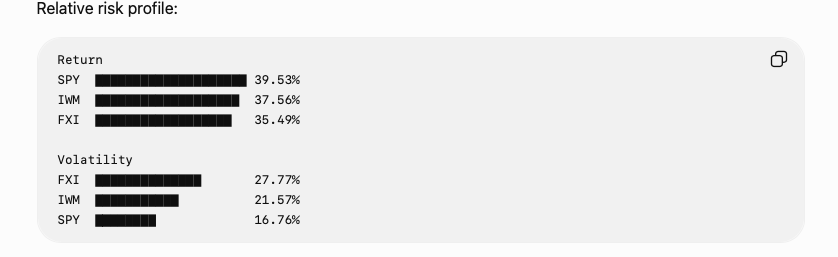
Source for bar chart: Codex by OpenAI. 07/18/2024-08/28/2026. Price Return, not Total Return with Dividends.
“Please Don’t Stop the Music”
However, as Chuck Prince once told the Wall Street Journal in 2006 (paraphrase), this market cycle is like a game of musical chairs: everyone keeps playing, but everyone knows the music will eventually stop.
The music is indeed stopping in its current modality. In Texas, the previously pro-dev Governor announced he is requiring AI Hyperscalers to de facto vertically integrate power supply to their capital allocation process, so as not to strain the grid. In Pennsylvania, the previously pro-Data Center Governor announced a ban on new development. Mr. Sam Altman eloquently opined on the David Senra podcast posted on X in August 2026 that the AI industry has done a terrible job at storytelling.
Instead of seeing human flourishing– as Socrates and Saint Thomas Aquinas would put it– the cobbler, farmer, potter, and even many Guardians are teaming up to form a blocking flank on both the right and the left in America for net new development. This band doesn’t see the boundless potential of human flourishing with Data Center expansion. They see human mystery.
This is a serious matter for LLM labs– to be or not to be, that is the question, to build or not to build, that is the answer. At the current juncture, the NPV on a risk-adjusted basis of owning the entire power-utility-physical infrastructure on essentially a R&D special operating purpose vehicle’s previously light balance sheet, is tantamount to ROIC suicide. Death by a thousand D&A line items.
Therefore, with Oracle’s 5Y CDS now close to 200bp due to fears of balance sheet leverage thanks to asset heavy capitalisation of the vertical data center infrastructure stack, it is important to pause– and examine where to pivot– to re-examine the three key takeaways from Professor Greenwald & Co. from Columbia Business School’s Value Investing institution.
Columbia we Have a Problem– Capital, Credit, Compute
One of the core disciplines taught at Columbia Business School is systematic value investing. The rules of the road for creating value index fund baskets were laid out by Dr. Dodd and Dr. Graham’s Security Analysis and Intelligent Investor nearly 100 years ago. Mr. Warren Buffett updated those theories with practical lessons from investing at Buffett Partners and Berkshire Hathaway in his many Essays of Warren Buffett, and further updated with tech ecosystem examples by Dr. Bruce Greenwald.
It boils down to the notion that owning cheap stocks isn’t good enough. There’s value traps galore in the market. JCrew’s fin crisis era LBO was one of them– within several years it filed for Chapter 11 (disclosure: the author of this note was at Morgan Stanley and took the “other side” of the LBO trade in a CBS M&A dissertation in 2014). “Price is what you pay, value is what you get”, as Mr. Howard Marks, CFA famously said on Bloomberg TV during that era.
It’s the process of owning a concentrated basket of equity– at the right intrinsic value catalyst point– that matters. It’s where the NOPAT must exceed the product of the Invested Capital by the Weighted Average Cost of Capital on a sustainable basis. Higher leverage on the balance sheets tends to raise the Cost of Capital from a debt risk premium– and an equity beta standpoint.
Therefore, catalysing ROIC compression, much like investors witnessed with large-cap banks during the European Sov Debt Crisis years. If ROIC does not Exceed that product function, then there is no tangible nor meaningful economic profit– the enterprise should simply be liquidated to pay its creditors back.
The interesting pivot point the market faces is deciding American LLM capital stack gamma risk premium. Thus, the key couple of points are;
Will there be sustainable ROIC for vertically integrating expensive (from upfront balance sheet “crowding out” risks to downstream D&A vol) that surpasses outcome-oriented LLM model adjusted WACC?
How will the LLMs Labs best monetise licensing uncertainty risk premium data modulation?
If the answer to the first question is no, then there will be convergence towards mere nominal GDP, and thus no investment rationale above a 10-15 earnings multiple and 150-300bp credit spread range (note, H1 hypothesis based off historical ranges for BBB credits with asset-heavy balance sheets).
That is because In LLM 2.0 Age, where electricity will run tight, per DuLac Capital Advisory’s Feb 2024 prediction, energy-efficient outcome driven models will prevail. However, the American Frontier LLM Lab that is able to best facilitate and enable its clients (enterprise, small business, and consumers alike) to modulate the known unknowns, will be the victor.
Therefore, Economic Utility factored by a Gamma Uncertainty Risk Factor Premium per unit of GW of Power factored will become a standard for capital allocation.
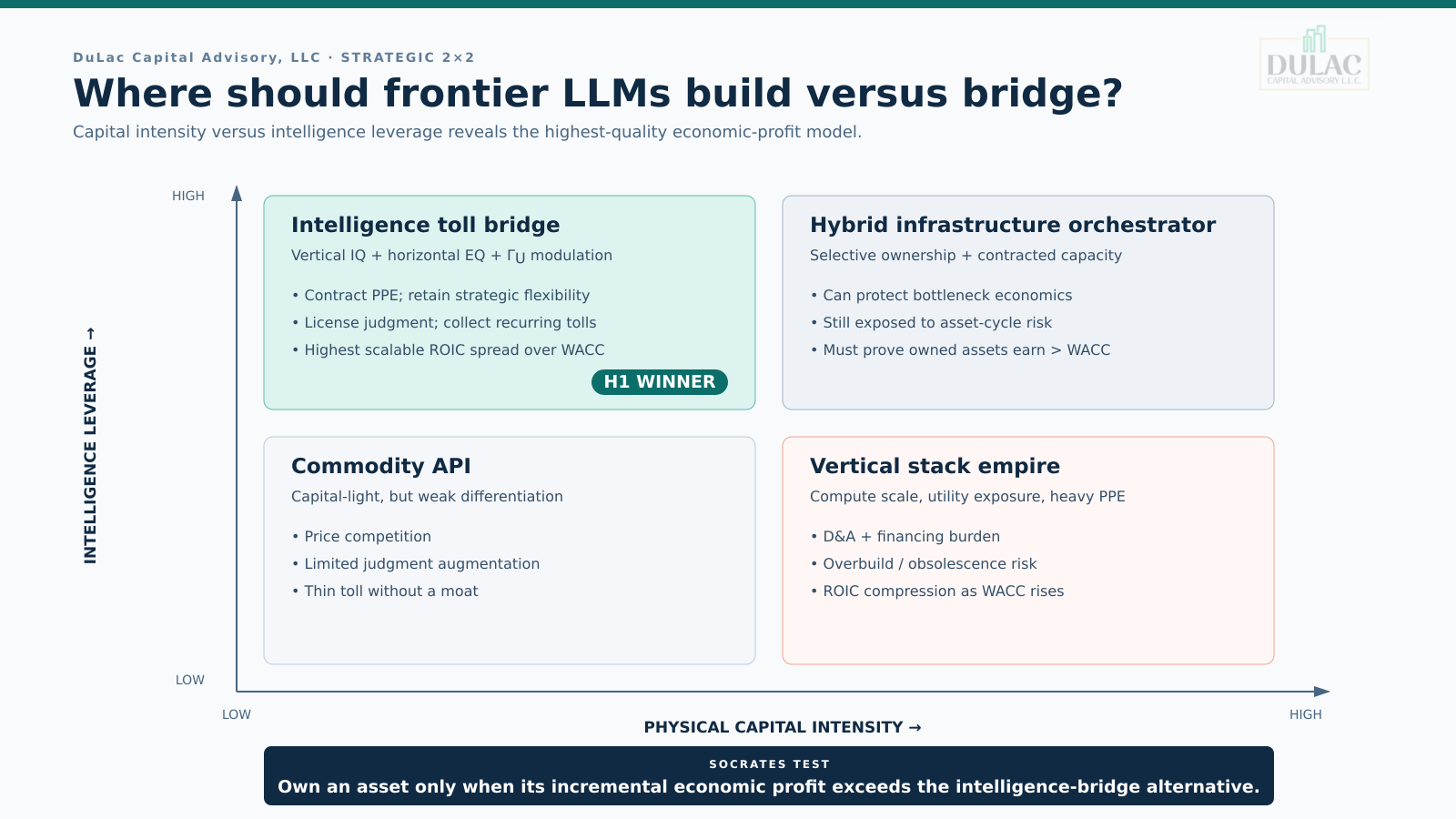
Research from DuLac Capital Advisory, L.L.C. Visualisation of thesis by ChatGBT Work by OpenAI.
Miles Davis’ Modes: Sigma and So What
Imagine: it’s 1959 and Miles Davis is set to play at a speakeasy in Brooklyn. You want to attend but the new Eisenhower highway was blocked off for Cold War military drills, so you miss it. So does everyone else. NYPD finds out about the speakeasy, so blockades it, preventing local beatniks from even attending. It’s simply Miles Davis and his trumpet. Imagine he starts performing the riffing on the hallmark solo from Kind of Blue, “So What”, anyways. No one else is there. He just enjoys the IQ and EQ feedback mechanism– he enjoys the process, so keeps playing. Is this a concert? Did Miles Davis “orchestrate” intelligence? Coltrane and Cannonball weren’t able to make it either due to traffic: simply Miles.
Most people would answer the way they answer the question about whether a tree makes a sound if it falls in the forest and no one is there– does it actually make a “sound”. Heisenberg’s principle of the uncertainty observation. That is where the bread and butter for American LLM Labs will be in the 22nd century: the process of creating new riffs– the mechanism for bonding new memories for future observation, even if no one currently is there in the present to appreciate its value. Miles Davis, after all, famously used to purposely skip notes when improvising– and would even turn his back to his audience when playing. He loved the process.
The American LLM Lab that can best initiate the process of building emotional connectivity in society, thus enabling flourishing of humanity, will be the one that generates excess ROIC relative to GW and Gamma Uncertainty Risk Premium factored WACC. They will be the one that enjoys the mid above median earnings multiple (akin to the SaaS heyday average observed in iShares S&P Expanded Software ETF IGV in 2023-2025. The ones that end up seeking to become BHAC but with a super computer, will compound to below the median multiple over the medium term horizon (note: this a DuLac Capital Advisory secondary H1 Hypothesis for institutional investors, not established fact).
Put it simply, would it have been a more efficient allocation of capital for Miles Davis’ record company to own the myriad of speakeasies in NYC that host Jazz, or would it have been better to have invested in “licensing and brokering” the royalty rights of his music? America-First Frontier LLMs can become the value realization platform for the American Artisans of the mid 21st century. Why? Creativity can exist in a vacuum– value realisation though usually cannot. American LLMs can be an enabler of this platform, not a disabler: a TFP Expansion, not Contraction.
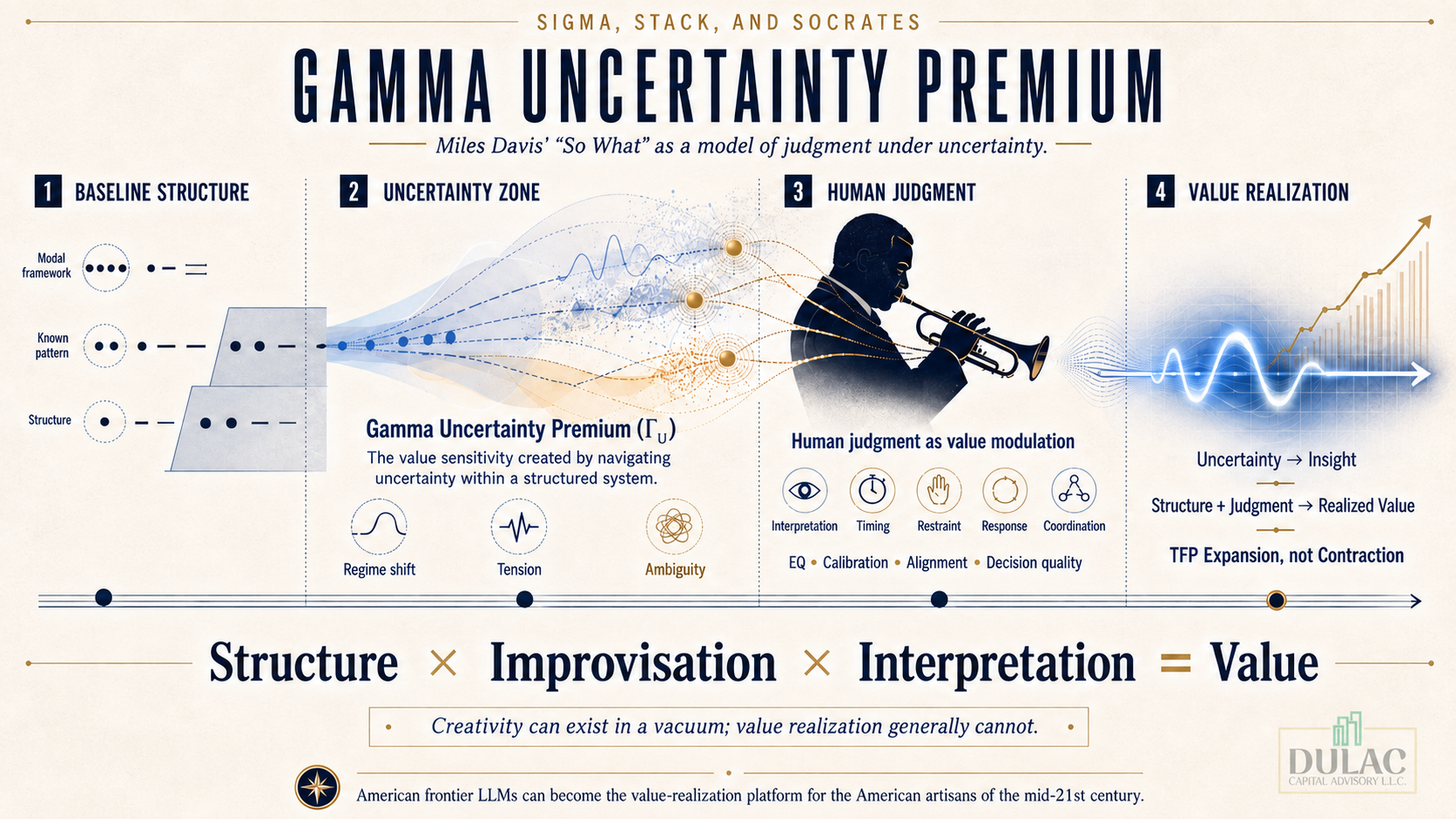
Miles Davis often skipped a note on purpose— in order to add tension and space to the modality of the song. Visualization by ChatGBT Work.
Comebacks and Creators– The AI enabled Artisan Economy
Jordan 1996. Woods Augusta 2019. Trump 2024– Americans love a comeback story. When Steve Jobs made his return to Apple in 1997, they revamped the Mac personal computer. However, rather than showcasing its product specs, he narrated a minute commercial about the endless possibilities of a society where tech is a platform that enables, not disables, the “Crazy ones”-- the ones who see things differently: Think Different.
Every older millennial and GenXer in the City of New York remembers three things: what they first did in the aftermath of 9/11, where they were when Justin Tuck sacked Brady at the Giants Super Bowl Victory in 2012, and, who they invited with them to go see Broadway genius show, Hamilton.
American LLM Labs, thanks to the Anglo-American free enterprise system, sit at the precipice of (not “orchestrating”), but rather “jazzicize” the proliferation of near- boundless opportunities for enhancing human flourishing and potential through their uncanny ability to barbell high machine-native IQ, with biological human EQ. Commerce, Consumerism, Academia, and especially small businesses too poor to afford expensive SaaS, all stand to benefit.
The pivot will simply have to be two things:
Data centers in Space (“Space-tech as a Service”); SpaceXAi and Blue Origin have been in the news on neocloud models in space.
Not place asset-heavy power plant infrastructure, with its high D&A and low multiple, on their balance sheet. Nor through clever now, but pain tomorrow, special-purpose vehicle financial instruments, that S&P Global recently warned will require tremendous credit research.
Millennials, GenXers in finance have seen that movie before. It led to institutional banking being relegated to utility multiples, yet without utility lifestyles for their workers for much of the 20-teens. It led to social upheaval in the USA, such as the Occupy Wall Street movement. That led to the rise of the DSA becoming mainstream.
Currently, American LLM Labs are underpricing the tremendous value of a royalty rights “IQ” streaming-as-a-service system: particularly to help augment human EQ. The portion that a machine will generally misprice the gamma uncertainty risk factor premium of EQ. That’s due to the 2022/2023 LLM 1.0 vintage being to estimate what the median prompter seeks in an answer. However, prices– and emotional experiences as referenced above– are always set at the margins. The tails. That’s why R2D2 will always need a Luke Skywalker.
LLMs will always need humans: and the LLM Lab that supports an ecosystem of “Flourishing Fortresses” for small businesses, will win the day. That is especially the case once they connect those Flourishing Fortresses with Bridges of Opportunities of Civic Happiness, as Prof. Glenn Hubbard penned. Bridges of EQ connectivity, not Moats of terrestrial “scarcitymaxxing”, will be the way to carpe diem. In this mode– where human creativity is enhanced by LLMs, not wrecked by it– those potters, stone mason cobblers, and farmers will lead the way ahead of the “Guardian” class with increased, not decreased, LLM adoption.
They will be net receivers, not payers, of that IQ vs EQ Royalty Rights Swap. Legacy Enterprise companies that spend capital building frivolous “data moats” will be the net payers to the balance sheet-light American LLMs. Thus, For the Artisan AI economy, “Long Float, Short fixed”; that is as long as the premier American LLMs construct those horizøntal bridges– and decide to skip a couple notes on the chord progression.
Epilogue: Closing Questions Out Early in AI Era Eliminates Upside Vega Risk
In summer 2018, as a senior VP at BlackRock’s institutional iShares ETF & Index team, I was asked by the second-in-command of the Thematic ETF Product Strategy team to do a presentation on the firm’s latest product launch: AI managed sector index funds, iShares Evolved Sector ETFs. The concept was simple: the proliferation of compute will cause sectors to rapidly evolve. Apple is a tech company but also is a consumer services company– and a financial company– yet, standard sector indices placed the entire equity beta of Apple in only one sector. The EQ of the pitch was the hard part. There was no ChatGBT to sound off on how to mitigate Anchoring Bias strategies back then.
Therefore, iShares AI enabled sector funds would make sure your sector funds have exposure to companies with meaningful economic profit from every sector they compete in. The BlackRock Machine Learning system did the leg work; humans did the spot check of the portfolio rebalancing. That was the easy part. The hard part was convincing other humans of the need for compute to augment the investing process. The head of the Pension Sales team soaked up 75% of the aftermarket presentation with skeptical questions that boiled down to: “institutional investors don’t want computers picking their stocks.”
“True”, I retorted politely to the MD:
“However, Institutional Investors, though, will one day want learning machines to augment human stock pickers; akin to humans using machines to check the pressure of the car tires in the winter.”
A simple “thumb check” may do in the posh sunny hills of the firm’s SF Office. However, in the mean streets of New York– a machine is utilised to gauge the “gamma uncertainty risk premium” of whether that tire truly has enough air to make it down second ave’s bumpy roads.
BlackRock ended up closing those five funds three months before the launch of ChatGBT by OpenAI; imagine the data that could be leased back to a leading LLM if they were kept open.
The venerable firm, BlackRock, is now part of a consortium with Blackstone, Goldman Sachs, KKR, Brookfield and NVDA to scale out the “financialisation” of enterprise LLM compute. Replicating BHAC but with a super computer front-end interface, is just now starting to be recognised as tougher than meets the eye. The catalyst is now before that massive gamma of D&A uncertainty risk premium is actually realised on the bottom line.
DuLac Capital Advisory was launched in fall of 2021 to help enterprises leverage AI for their ALM investment decision-making process. The firm may purposely skip some notes in public pieces, but hopes to never miss a beat.
Ryan Scott
Managing Principal— DuLac Capital Advisory, L.L.C.
(+1) 202-503-5990
Please add your contact information in the Message Box at the bottom of website to receive institutional research and case studies. Thanks!
https://www.dulaccapitaladvisory.com
Investment News, Market Insight, and Investment Insight Disclaimer
The information, investment news, and policy insights provided by DuLac Capital Advisory L.L.C. ("the Firm") through its publications, reports, newsletters, and communications, including but not limited to Investment News, Market Insight, and Investment Insight, are intended for informational and educational purposes only. These materials are not to be construed as specific investment recommendations or advice. DuLac Capital Advisory L.L.C. is a technical services management consultant for companies and institutional investors. DuLac Capital Advisory L.L.C. does not receive any revenue from any company or service mentioned in this insight piece.
Not Investment Advice:
The materials provided by the Firm do not constitute investment advice or recommendations to buy, sell, or hold any securities or investment products. The insights offered are general in nature and do not take into account the individual circumstances, investment objectives, risk tolerance, or financial situation of any particular institutional investor or recipient.
No Reliance:
Institutional investors should not rely solely on the information provided by the Firm for making investment decisions. It is recommended that investors conduct their own due diligence, seek advice from qualified financial professionals, and carefully consider their investment objectives and risk appetite before making any investment decisions.
No Guarantee:
While the Firm strives to provide accurate and up-to-date information, there is no guarantee of the accuracy, completeness, or reliability of the information provided. The financial markets and economic conditions are subject to change, and the information provided may become outdated or irrelevant over time.
Risk Disclosure:
Investing in financial markets involves inherent risks, and the value of investments may go up or down. Past performance is not indicative of future results. Institutional investors should be aware of the potential risks associated with investment decisions and should consult with professionals who are qualified to provide personalized investment advice.
No Endorsement:
Any mention of specific securities, investment products, or companies does not constitute an endorsement, recommendation, or promotion of those securities, products, or companies by the Firm. The inclusion of any such information is for informational purposes only. No compensation was received from including any investment product or technology into the White Paper.
Legal and Regulatory Considerations:
Institutional investors are responsible for understanding and complying with all applicable laws, regulations, and guidelines related to their investment activities. The Firm's materials are not intended to replace or substitute for legal or regulatory advice.
The Firm disclaims any liability for the use or interpretation of the information provided in its materials. Institutional investors should use their judgment and exercise caution when relying on any information provided by the Firm.
For personalized investment advice tailored to your individual circumstances, we strongly recommend consulting with licensed financial advisor at a major Wealth Manager.
All content published by DuLac Capital Advisory L.L.C. is Copyright Protected per U.S. law. Insight is protected speech and right to commerce per U.S. Constitution and Civil Rights Act of 1866, Civil Rights Act of 1871, and Civil Rights Act of 1964.