

The Hamilton Model— Master Inventor, Master Builder: A Template for Continued Innovation in AI America
Investment Policy Piece: Innovation Incentives for Inventors
A couple of weeks after Independence Day, 2024, DuLac Capital Advisory, L.L.C. published a note predicting that not only had America won the “Trump Trade War” vis-à-vis Mainland China, but it did so via unleashing innovation in the AI and Tech Space via Milton Friedman-like investment incentives. As America enters its 250th anniversary since the signing of the Declaration of Independence and hence taking on the most unrivaled military power since the Roman Empire, it may benefit to take a step back to in time to America’s Elon Musk of that era: Colonel Alexander Hamilton of Columbia University.
According the the acclaimed biography, Alexander Hamilton, by Ron Chernow, Colonel Hamilton quickly noticed the expediency for the budding nation to shore up three factors:
Monetary Policy: The colonies printed money not backed by any collateral save net export revenue, which collapsed due to the war with Great Britain.
Industrial Policy: America needed to produce textiles and manufacture hard goods for its defense and manufacturing capacity.
Institutional Financial Infrastructure: America not only needed a strong Central Bank, but it also needed American citizen-capitalized, vibrant commercial banks to nurture its growing capital markets and industrial expansion— for American citizens, by American investors.
Hamilton was “Mr. Fix It”, forging a path through theory and practice to generate a separate, although adjacent, economic opportunity zone— with thriving civil society— to the prevailing European giants at the time. Thankfully, the enterprising investor brought the right tools to the American experiment.
Hamilton’s Solution: American Enterprise Inelasticity through Innovation
Today, America basks in the fruits of Colonel Hamilton’s intelligence, labor, industriousness, grit, and inventiveness. From the New York Stock Exchange to U.S. Treasury Bonds, to America’s Space Industry led by SpaceX and Blue Origin, the enterprising Colonel Alexander Hamilton footprint is evident. If General George Washington was (and literally laid) the cornerstone to America’s polity and civil society— the first Secretary of Treasury of the United States laid the industrial and financial keystone to America.
There was a viral post on X (formerly known as Twitter) from a British poster that cheekily compared America’s 250 year independence to the fact that his local pub is about 4x the duration of the world’s oldest continuing constitutional republic. His post misses the point: Alexander Hamilton was an autodidact— studying much of the Western Cannon— and was fluent in French and Latin. He looked at scores of examples of past empires, kingdoms, and cantons in Western Civilization for inspiration on how to craft America from the best case studies (source: “Alexander Hamilton”, Chernow).
If Hamilton was the spirit of America, European civilization was its spark: from modern Navies, to a professional Army to modern fiscal financing mechanisms, to sovereign debt restructuring, Alexander Hamilton’s various inventions stood on the shoulders of 2000 years of Western Civilization Giants. Hamilton was as well versed in Aristotle and Cicero as he was in the history of the Medici.
Most people on Wall Street are familiar that Alexander Hamilton invented the modern day New York Stock Exchange (NYSE). However, he also was an investor of several other key cornerstones of America— for his era, he was as industrious as contemporary rocket scientist and engineer, Elon Musk.
NY Delegate/Treasury Sec. Alexander Hamilton invented:
The NY Bank (with $350K market cap)
The taxpayer owned USA Central Bank
The Coast Guard
The Professional American Military
Top Steam engine based Textile Company (Paterson, NJ)
Independent Judiciary
Restructured the US colonial debt stock: inventing modern day U.S. Treasury bonds.
The Federalist System of Government (along with Madison and Washington)
BNY Case Study: Hamilton was Fearful when Others were Greedy, yet Greedy when Others were Fearful:
Time in the market trumps timing the market is an old but true adage on Wall Street Secretary of Treasury Hamilton’s top company invention (modern day Bank of New York BNY ) was made available to the private investors in the late 1780s, and listed to public investors on NYSE post Button Woods Agreement in 1790s. He wanted all Americans to be able to have the opportunity to participate in the fruits of its productive success.
$500 invested in Sec of Treasury’s Bank of NY (modern day BNY Mellon) post Buttonwood Agreement would have accumulated to $500K today: not even including dividend reinvestment. This means Mr. Hamilton invented a company that has produced a cumulative return of 20,000%— about a 5.5% CAGR (again, not even including dividends) per analysis done on Grok. That is despite 5 major financial crises, massive competition, and a few inflationary wars.
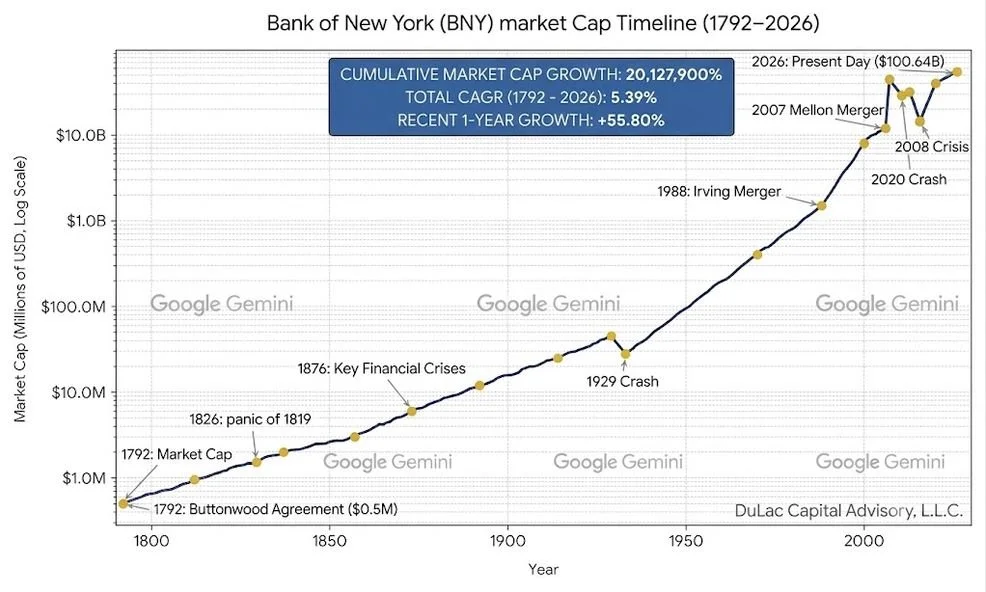
BNY Mellon has generated 5.39% CAGR— not including dividends— since its listing on NYSE post Buttonwood Agreement in 1792. Source: Google Gemini as of 07/04/2026
Modern America Mobility- the Hamilton Framework
If America was such a lousy place with no mobility for those with grit & smarts, his heirs would be multi billionaires: practical American Aristocracy.
The fact that they are regular American citizens, who cherish history of their forefathers, speaks volumes to his vision for our great country. Secretary Hamilton conceived an America where merit and grit tops pedigree and privilege over time.
The zeitgeist Broadway Musical, “Hamilton,” made the Colonel Hamilton’s meteoric rise from an self-educated trading clerk in Nevis/St. Croix, to the chief Aid for General George Washington during America’s War for Independence. The BNY case study is a simple example of his foremost intuition—and invention: modern-day capital markets made available for the average American.
It is the simple future value formula (FV = Principal x (1 + IRR)^N) that NY Delegate Hamilton scaled out via his deftly orchestrated foundation of the modern New York Stock Exchange. Similar to how President Washington refused to become a quasi-monarch by stepping down from power after only two terms, Hamilton likewise expanded the “franchise” in the American Enterprise and civil society by enabling its citizens to invest in its nascent, yet vibrant, industry through the capital markets.
Trump Accounts: a Modern Day Hamiltonian Solution for Mitigating Mobility Gaps in the AI Era
Instead of creating a New World Nobility, as Virginia Delegate Thomas Jefferson feared, Colonel Hamilton’s inventiveness and foresight enabled America to have a path forward for middle-class wealth mobility. As Columbia Business’s most luminous grad, Warren Buffett famously said: “If you don’t have a way to earn money while you sleep, you’ll work until you die.” It was Colonel Alexander Hamilton that invented the platform to enable every day working Americans to translate their work to compounding wealth—thus enabling something to pass on to the next generation.
It was recently announced that the “Trump Accounts”, which act as a mobility-enhancing 401K for American youth born since 2025, were gifted with $320 Million in SpaceX stock by its CEO, Ms. Shotwell. Additionally, American Chip Giant, Micron, is gifting $250 Million to the Trump Accounts. Ditto for founder of Dell Computers, Mr. Michael Dell, with his foundation’s seed capital of an eye-popping $6.25 Billion: amounting to $250 for 25 Million eligible American kids. In the home-state of the University of Notre Dame du Lac, Indiana, CIO of Altimeter Capital, Mr. Brad Gerstner, will be seeding Trump Accounts for all eligible Hoosier kids.
These are all examples of the American Enterprise in action: voluntary, yet meaningful economic mobility facilitation through the American Capital Markets— not Big Government Mandates. Hamilton saw America as the future weigh-station for global commerce: where the local States’ regional competitiveness would not be a hurdle to clear— not a hamstring to pull— in its race against powerful European economies that had it all at the time.
Alexander Hamilton: We Invest a Share For You
Furthermore, the fact that Colonel Hamilton chose not to keep his inventions closely held by creating a trust where only he and his heirs were majority shareholders, meant America would become a shareholder citizen based society— not a Monopolistic Oligarchy.
Although Secretary of Treasury Hamilton only lived to 49, his spirit remains a continued hallmark for America’s entrepreneurial spirit: his ideas and innovation continue to sustain this flame of excellence. As General Washington enabled the U.S.A. to be a nation-state of Invictus, Colonel Hamilton’s prescient insight has enabled America to remain Excelsior over the last quarter of a millennium.
Ryan Scott
Managing Principal— DuLac Capital Advisory, L.L.C.
(+1) 516-939-6833
Please add your contact information in the Message Box at the bottom of website to receive institutional research and case studies. Thanks!
https://www.dulaccapitaladvisory.com
Investment News, Market Insight, and Investment Insight Disclaimer
The information, investment news, and policy insights provided by DuLac Capital Advisory L.L.C. ("the Firm") through its publications, reports, newsletters, and communications, including but not limited to Investment News, Market Insight, and Investment Insight, are intended for informational and educational purposes only. These materials are not to be construed as specific investment recommendations or advice. DuLac Capital Advisory L.L.C. is a technical services management consultant for companies and institutional investors. DuLac Capital Advisory L.L.C. does not receive any revenue from any company or service mentioned in this insight piece.
Not Investment Advice:
The materials provided by the Firm do not constitute investment advice or recommendations to buy, sell, or hold any securities or investment products. The insights offered are general in nature and do not take into account the individual circumstances, investment objectives, risk tolerance, or financial situation of any particular institutional investor or recipient.
No Reliance:
Institutional investors should not rely solely on the information provided by the Firm for making investment decisions. It is recommended that investors conduct their own due diligence, seek advice from qualified financial professionals, and carefully consider their investment objectives and risk appetite before making any investment decisions.
No Guarantee:
While the Firm strives to provide accurate and up-to-date information, there is no guarantee of the accuracy, completeness, or reliability of the information provided. The financial markets and economic conditions are subject to change, and the information provided may become outdated or irrelevant over time.
Risk Disclosure:
Investing in financial markets involves inherent risks, and the value of investments may go up or down. Past performance is not indicative of future results. Institutional investors should be aware of the potential risks associated with investment decisions and should consult with professionals who are qualified to provide personalized investment advice.
No Endorsement:
Any mention of specific securities, investment products, or companies does not constitute an endorsement, recommendation, or promotion of those securities, products, or companies by the Firm. The inclusion of any such information is for informational purposes only. No compensation was received from including any investment product or technology into the White Paper.
Legal and Regulatory Considerations:
Institutional investors are responsible for understanding and complying with all applicable laws, regulations, and guidelines related to their investment activities. The Firm's materials are not intended to replace or substitute for legal or regulatory advice.
The Firm disclaims any liability for the use or interpretation of the information provided in its materials. Institutional investors should use their judgment and exercise caution when relying on any information provided by the Firm.
For personalized investment advice tailored to your individual circumstances, we strongly recommend consulting with licensed financial advisor at a major Wealth Manager.
All content published by DuLac Capital Advisory L.L.C. is Copyright Protected per U.S. law. Insight is protected speech and right to commerce per U.S. Constitution and Civil Rights Act of 1866, Civil Rights Act of 1871, and Civil Rights Act of 1964.