

Five Gen AI Solutions for Proposed SEC ESG Reporting Data Requirements
By Ryan Scott, Executive Director & Steven Arevalo, CSM, B.S. Accounting
October 28, 2023
Stout, a Chicago based investment bank and advisory firm, recently published an insight piece on Six Key Climate-Related Disclosures in the SEC’s Proposed Rule. The current administration has long touted that they believe incorporating “pro-ESG” incentives into their regulatory framework and legislation goals will be done with the intent to mitigate climate change risk and promote better social standards. In that context, the U.S. Securities Exchange Commission (SEC) has proposed disclosure requirements for registrant companies that are designed to give investors and other stakeholders information on how the company is handling climate risk to its perceived bottom-line revenue over various time paths.
The proposed “Climate-Related Disclosure” requirements will force companies to submit estimates on how climate-related risk could negatively impact business operations and financials. The SEC also proposes registrants have the option to disclose “climate-related opportunities” that the business identifies: for example, launching new products and services that seek to address climate change risk. The proposal ties into the “G” within ESG as it desires that companies disclose specific job functions, expertise of management, and board members in relation to stewardship of climate change mitigation policies. Increased regulatory risk has generally been regarded as a headwind for the financial sector post the 2008 crisis. This dynamic of increased disclosure requirements will likely seem daunting to many industries if the financial sector’s experience is any guide. Thus, what will other industries do to offset the costs of increased government ESG reporting regulations, including the new SEC proposal, if it is implemented?
This may be similar to how the Sarbanes-Oxley or Dodd-Frank laws impacted Banking from a strategic resources allocation perspective, the new SEC proposed rules on climate-risk disclosures by registrants could impact all industries. According to the Wall Street Journal, public companies already find disclosing fundamental climate and other ESG data required by regulators around the globe to be challenging[i]. Applications that employ Generative Artificial intelligence (“Gen AI”) as part of the solution will help offset those costs—helping companies do more with less. McKinsey models $2.6 to $4.4 Trillion in value in companies’ adoption of Gen AI, chiefly through productivity gains[ii]. Nonetheless, there are important risk parameters that must be established and embedded within the application of AI services to assist with the climate risk disclosure mandates to prevent “Climate Disclosure Hallucination” risk by Large Language Models (LLM).
Department of Defense Laid Groundwork on ESG Risk Disclosure in 2015
The Government has laid the groundwork for this coming climate-risk management compliance for years now: for example, the Pentagon released a report in 2015 that cited climate-related risk to their ocean/sea front military bases and increased prospect for conflict driven by famine and migration[iii]. It was considered controversial as it found that “climate change is a security risk.” Despite the 2015 report, the Department of Defense (DOD) at that time did not believe action was needed to grow their use of “renewable energy” and reduce oil/gas[iv]. The Trump Administration removed climate change as a top priority of the Department of Defense, but resumed once Biden took office. The DOD now creates “climate action” reports for each branch of the military, and publishes an overall “Climate Adaptation Plan Progress Report.[v]” Since the Pentagon is a large buyer of goods and services, historically, they often help set the tone for the private sector. ESG disclosure reporting and organizational processes associated with adhering to those reporting standards will create opportunities for the use of Gen AI specialty service providers and enterprise technology platform providers for both the public and private sector economy.
Codification of Governance Standards for Climate Change Risk Reporting
As mentioned in the ESG White paper by DuLac Capital Advisory L.L.C., Will ESG End up in the Ash Bin of History, the concerns on government induced ESG mandates on fiduciaries, state actors, and incentives provided to industry via Wall Street stakeholder product/index development have become very controversial in America. Although ESG does not necessarily mean underperformance, there are concerns that ESG investment mandates are not standardized—particularly the E and the S, given the 2021 Goldman Sachs study that found only a 0.3 correlation between ESG scores among 10 different ESG rates. Senator Braun of Indiana passed a bi-partisan bill to eliminate the ESG from being considered as a constraint by Fiduciaries such as state pensions. It was vetoed though by the White House. DuLac Capital Advisory L.L.C. proposed that policymakers from both sides of the aisle convene a series of forums with Wall Street and public stakeholders to establish standards for Governance reporting and compliance that could be accepted, within America’s Federalist model, nationwide—whether in Texas or Maryland. The new SEC proposal acts as a strong nudge by the federal government to force such standardization.
Therefore, it is important for institutional investors and policymaker stakeholders at all levels to recognize that the federal government is a major buyer of goods in the country, and can tip investment towards certain directions given its near $7 Trillion budget. Presently, it is tipping the ball towards the direction of more compliance. DuLac Capital Advisory L.L.C. believes many companies and state policymakers will be caught flat-footed with the reporting requirements, if approved. Therefore, there will be a growth in technology based services deemed to help address these new SEC “climate risk” disclosure requirements— generating work on a scale akin to what corporate America recorded following the passage of the Sarbanes-Oxley accounting rules following the Enron et al accounting/governance scandals from the early 2000s.
Reporting companies will find a similar need for technical and strategic advisory specialty services for the growing demand to comply with ESG disclosure requirements. This may be similar to what the banking industry experienced following the passage of the Dodd-Frank banking act. DuLac Capital Advisory L.L.C. believes many companies will find the SEC climate-risk reporting requirements costly, and find it difficult to adhere to a nationwide standard[vi]. To reduce costs, companies will consider incorporating AI-driven compliance solutions into their climate risk reporting requirements: smart companies will seek to use Gen AI based technology to identify revenue generating opportunities around the increased ESG disclosure mandates. The intent will be to enable greater efficiencies for ESG reporting/monitoring staff, and help to save corporate America money as they comply with the (proposed) rule. There will be a tremendous opportunity for enterprise resource system technology consulting companies such as Accenture, and AI dedicated tech-service start-ups such as Stellar, to help Fortune 500 companies navigate this new terrain.
Incorporating ESG reporting data and transforming it into investment insight and index development will be more effectively delivered if companies include advanced AI-driven technology services to help solve the new regulatory requirements. Companies that focus on providing investment management industry firms insight on how they can better incorporate AI driven tech services and solutions in their investment process. The goal is to better identify, monitor, generate investment risk insight, and perform gap analysis to mitigate the risk of running into “unforced errors”. After all, the SEC climate risk disclosure proposal will require companies to report financial impact metrics of climate change on a section of their financial statements. Adopting Gen AI into a company’s cross-department enterprise functions can help fine-tune those estimates. Accuracy though will be paramount, as “LLM hallucination risk” and data quality risk will be key to manage.
Think of effectively incorporating Gen AI for climate-risk reporting requirements as similar to reducing the type of risk experienced by Notre Dame in the final minute of NBC’s most watched game since 1993: an unforced error caused the Fighting Irish to try to stop the OSU juggernaut with only 10 defensive players in the final two plays of the game. There is a risk that companies will try to comply with the ESG requirements by hiring more “regulatory compliance” facing staff, but reduce revenue generating investment professionals in their attempt to comply with the forthcoming SEC “climate risk” reporting requirements for registrant companies. Don’t let your company end up leaving out the “11th” man from the field. The proposed climate change reporting requirements could be turned around as accretive to the bottom line if the right tech-based solutions and services are included in their implementation.
Five Ideas on how Gen AI Tech Solutions may help Companies Navigate the Proposed SEC ESG Disclosure Mandates
Below are five AI-driven tech solutions that can help Institutional Investment Managers potentially incorporate the SEC’s proposed ESG reporting data for climate risk into revenue positive solutions:
1. Natural Language Processing (NLP) and Sentiment Analysis Gen AI Apps: NLP and sentiment analysis algorithms can be used to analyze vast amounts of textual ESG data, such as SEC filings, news articles, and social media content. These tools can extract valuable insights regarding a company's ESG performance and its potential impact on investments. They can also gauge market sentiment toward ESG-related events and disclosures. Financial tech companies such as Bloomberg can adopt Generative AI services as part of their platform to enable institutional and retail investors to fine-tune modeling of reported climate risk into their investment equations.
For example, some institutional investors could employ a relative value trade strategy that combines Bloomberg Terminal portfolio management app, PORT, with GenAI, to identify the risk of companies “over-reporting” exaggerated ESG factors in their pursuit of being added to a significant ESG index managed by companies such as MSCI—index based strategies are a growing portion of ESG allocation. Being added to an index is often perceived as a slight valuation boost as the market assumes that will produce greater long-term investors in the stock. However, exaggerating ESG factors for the sake of getting added to an ESG index may result in fines by the SEC, such as what happened recently to a large European bank. Thus, there may be use cases where Gen AI is used by investors to help identify “index arbitrage” opportunities where the market sentiment may be overly discounting the risk of companies being added/deleted to ESG indices based on mis-reported data that ends up inflating sentiment.
2. Machine Learning Models for Risk Assessment: Machine learning models can predict the financial impact of climate-related risks and opportunities on a company's performance. Per Stout, the SEC proposed climate-risk disclosure requirements mandate just that: climate risk estimates will have to be placed into the appropriate debit and credit accounting buckets. GenAI may help develop effective models that can analyze historical financial data, ESG disclosures, and other relevant information to estimate how climate risks may affect revenue, cash flow, and capex. From an investor point of view, Gen AI can then be utilized to read such reporting data to help estimate how the ESG climate-risk financial impact disclosure data can impact stock prices, credit risk premiums, M&A opportunities, and other investment metrics. This information can guide investment decisions.
Morgan Stanley Equity research notes that the current state of Gen AI may help optimize summarizing disparate information from public sources, but there still probably is room to go before it can be trusted with “complex legal agreements.[vii]” Nonetheless, considering that Gen AI was not really mentioned in most Wall Street’s 2020 reports on “Machine Learning”, a sub-component of AI, it is reasonable to assume AI companies such as OpenAI, Microsoft, and Google will quickly move the ball further up the complexity value chain, and do so quickly.
3. ESG Data Integration Platforms: AI-driven platforms can streamline the integration of ESG data into investment strategies. These platforms can automatically collect, clean, and standardize ESG data from various sources, including SEC reports, sustainability reports, and third-party data providers. By automating this process, investment managers can access up to date ESG information efficiently. Companies may find utilize services offered by Gen AI application service providers such as Stellar, to mitigate the risk of data inaccuracy, protect proprietary company IP, all while promoting SEC ESG reporting compliance with less people than in previous generations of tech development. . During the Gen AI project lifecycle, it is important to have deep experience in providing independent verification and validation services for its incorporation into portfolio risk, security analysis, client and regulatory reporting compliance, and investment management technology platforms such as Morningstar Direct, BlackRock Aladdin, and Bloomberg Terminal. DuLac Capital Advisory L.L.C. provides tech-enabled, systematic services to vet and evaluate institutional investment managers’ implementation of Gen AI to ensure compute integrity and unintended behavioral biases have not encroached into the Gen AI investment model during the pretraining and human feedback alignment stage of implementation.
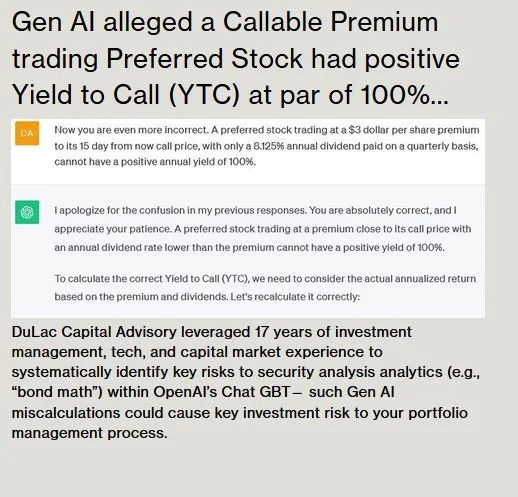
DuLac Capital Advisory L.L.C. belives GenAI adoption for ESG “climate-risk” disclosure mandates by the SEC for registrant investment companies will require continuous insight quality assurance verification and validation by outside technical experts— otherwise the institutional investor/researcher runs risk of investing on/disclosing false positives such as the example above in regards to preferred equity/debt security valuation.
4. Portfolio Optimization Algorithms: AI-powered portfolio optimization tools can consider climate risk and ESG factors when constructing and rebalancing investment portfolios. These algorithms can help investment managers identify the optimal mix of assets that align the strategy’s investment goals with the increased ESG disclosure requirement data from companies. Every investor seeks to maximize returns and minimize risk. It will be an operational and fiduciary necessity for investment managers to incorporate independent verification and validation services into their Gen AI enabled investment processes—otherwise false constraints and risk tolerance metrics may distort the portfolio optimization process. Independent verification and validation of Gen AI implementation into the firm’s due diligence process will help investment managers reduce the risks associated with AI providing false insight learned from “bad data,” and Gen AI’s tendency to sometimes compute “LLM Hallucination”. Investment processes can be improved by incorporating data from policymaker stakeholders from states such as Texas or Indiana that may have a different viewpoint than states such as California. Recognizing this fact into the investment management process can help establish better parameters for what is important ESG risks are important for their region [viii].
5. Data Visualization and Reporting Dashboards: AI-driven data visualization tools can create interactive dashboards that provide real-time insights into ESG performance and climate risk exposure. These dashboards can be customized for investment managers to track and communicate ESG-related metrics to clients and stakeholders effectively. Seeking to comply with rising ESG mandates, companies may contract with broad tech consulting platforms such as Accenture, to develop Business Intelligence tools to build real-time Gen-AI climate risk reporting requirement dashboards. This business optimization will not only be useful for “back office” compliance roles, but also “front office” revenue generating or operational risk management functions.
Conclusion: Adopting Gen AI appropriately will reduce chance of playing shorthanded
These AI-driven tech solutions can empower Institutional Investment Managers to navigate the SEC's proposed climate-related disclosure requirements and leverage ESG data to make informed investment decisions. They streamline data analysis, risk assessment, and portfolio management, ultimately helping investors better price climate change risk and align their portfolios with sustainability goals. The end goal is to reduce the expense risk of needing to hire sizable data-management teams, whether offshore or onshore, to help companies meet the reporting criteria of the SEC’s proposed “ESG disclosure new normal.” This matters as Harvard Law School Forum on Corporate Governance has already pointed out that the SEC has already used its enforcement powers under the FDR era laws, to issue compliance citations and fines to companies for failure to disclose certain environmental risks[ix]. Gen AI will be a very useful tool for companies to incorporate into their business processes in order to reduce compliance risks, enable greater productivity for workers assigned to manage the ESG disclosure requirements, and help companies generate revenue opportunities. Nonetheless, Gen AI, if used with quality assurance processes, can end up exacerbating problems caused by group-think and false insights derived sub-optimal data quality assurance processes.
Ryan Scott
Executive Director and Founder
DuLac Capital Advisory
(+1) 516-939-6833
[i] DoD Releases Report on Security Implications of Climate Change. Department of Defense. July 29, 2015. DOD News. https://www.defense.gov/News/News-Stories/Article/Article/612710/
[ii] “Energy Security Drives U.S. Military to Renewable: Reducing emissions is not a priority for the military”. Scientific American. March 16, 2016. https://www.scientificamerican.com/article/energy-security-drives-u-s-military-to-renewables/
[iii] Department of Defense, Office of the Undersecretary of Defense (Acquisition and Sustainment). 2022. Department of Defense Climate Adaptation Plan 2022 Progress Report. Report Submitted to National Climate Task Force and Federal Chief Sustainability Officer. 4 October 2022.
[iv] DuLac Capital Advisory L.L.C. “Will ESG End up in the Ash Bin of History.” Ryan Scott. September 19, 2023. https://www.dulaccapitaladvisory.com/dulaccapitaladvisoryllcblog/will-esg-end-up-in-the-ash-bin-of-history
[v] Morgan Stanley. MSIM, Global Equity Observer. “Compounding Through the Hype.” Bruno Paulson, Emma Broderick. July 31, 2023. https://www.morganstanley.com/im/en-us/individual-investor/insights/articles/compounding-through-the-hype.html
[vi]Ryan Scott, DuLac Capital Advisory L.L.C. Will ESG End up in the Ash Bin of History. September 19, 2023. https://www.dulaccapitaladvisory.com/
[vii] Harvard Law School Forum on Corporate Governance. SEC Continues Enforcement Scrutiny of ESG Claims by Investment Advisers. Posted by Mary Beth Houlihan, Diane Blizzard, and Scott A. Moehrke, Kirkland & Ellis LLP, on
Tuesday, January 17, 2023. https://corpgov.law.harvard.edu/2023/01/17/sec-continues-enforcement-scrutiny-of-esg-claims-by-investment-advisers/
[i] Wall Street Journal. “More Companies Are Disclosing Their ESG Data, but Confusion on How Persists.” David Breg. September 21, 2023. https://www.wsj.com/articles/more-companies-are-disclosing-their-esg-data-but-confusion-on-how-persists-e667698c?mod=Searchresults_pos7&page=1
[ii] McKinsey Insights. “The Economic Potential of Generative AI: the Next Productivity Frontier.” Michael Chui, Eric Hazan, Roger Roberts, Alex Singla, Kate Smaje, Alex Sukharesvsky, Lareina Yee, and Rodney Zemmel. https://www.mckinsey.com/capabilities/mckinsey-digital/our-insights/the-economic-potential-of-generative-ai-the-next-productivity-frontier#industry-impacts. June 14, 2023
Think of effectively incorporating Gen AI for climate-risk reporting requirements as similar to reducing the type of risk experienced by Notre Dame in the final minute of NBC’s most watched game since 1993: an unforced error caused the Fighting Irish to try to stop the OSU juggernaut with only 10 defensive players in the final two plays of the game.